
The fragile cargo dilemma: How to configure stacking restrictions without losing cargo space
In the logistics sector, planning the stowage of a container demands a constant balance between the safety of the merchandise and the efficiency of transport costs. When managing fragile and delicate cargo (such as food, electronics, or liquids), the technical challenge increases notably.
The main objective of operations managers is not only to ensure that the products arrive intact at their destination, but to prevent the destruction of fragile cargo, resulting in a waste of useful transport volume.
The economic impact of deficient stowage on fragile cargo
Any error in the distribution and lashing of the cargo compromises the profitability of the entire supply chain. When delicate merchandise is transported, the consequences of incorrect planning translate into critical operational costs:
- Loss due to fatigue and compression: It is a common mistake to assume that stable palletizing at the loading dock will withstand the journey. Under the constant vibration of maritime transport, the boxes at the base suffer mechanical fatigue. If medium-density products are stowed (such as liquids in PET containers or dairy products in cartons) exceeding the compression resistance limit (BCT), the lower packaging yields, causing the collapse of the column and the crushing of the product.
- Shrinkage due to wet collapse (Domino effect): In the transport of bottled liquids (wines, oils, or beverages), the breakage of a single bottle in the upper levels due to an impact is catastrophic. As the liquid leaks, the corrugated cardboard of the lower pallets absorbs moisture by capillarity, losing up to 70% of its structural resistance. This triggers a gravity collapse of the entire stowage hours later.
- Rejection of merchandise due to suspicion of damage (White goods and electronics): In high-value sectors, pallets usually incorporate tilt or impact sensors (TiltWatch/ShockWatch). If the container experiences slack due to a bad calculation of space, these sensors will activate. Although the product does not present external aesthetic damage, the customer at the destination will reject the entire batch as they cannot assume the factory warranty for equipment that has suffered out-of-range impacts.
Reports from the international insurer TT Club consistently reveal that nearly 65% of all merchandise damage in the multimodal chain is caused by deficiencies in packaging, improper weight distribution, or the incorrect lashing of cargo inside the container.
Physical factors in transport: Why free space destroys delicate cargo
To prevent the breakage of sensitive products, it is fundamental to understand the dynamic forces to which the container is subjected. During maritime navigation, the vessel experiences constant movements that directly affect the cargo:
- Rolling (roll): Transverse movement (from port to starboard). It is the main cause of pallet overturning.
- Pitching (pitch): Longitudinal movement (from bow to stern) caused by front swell.
What happens if we leave free gaps in the container?
According to the guidelines of the CTU Code (IMO/UNECE), any empty space exceeding 15 cm between packages or between the cargo and the walls of the container must be blocked.
This is where the benefits of planning container loads digitally come in, since calculating the blocking of cargo manually is complex. If this space is not secured, the forces of inertia generated by the rolling and pitching of the ship act like a hammer. The pallets slide and hit repeatedly against the steel walls of the container or against other pallets. This empty space does not act as a shock absorber; it multiplies the energy of the impact, bursting packaging and destroying the most vulnerable merchandise.
Fundamental principles for an efficient stowage of fragile cargo
To coordinate merchandise safety with space optimization, operations personnel must apply three strict physical rules:
- Mass distribution by gravity: Placement of the heaviest and most rigid elements at the base of the container (for example, pallets of canned goods or dense raw materials) to keep the center of gravity as low as possible, reserving the upper levels for the lightest articles or those with weak packaging.
- Compaction and blocking without slack: The goal of satisfactory stowage is to create a “solid block.” If the geometry of the load prevents it from fitting perfectly, those intermediate gaps must be covered with lashing systems or inflatable air bags (dunnage bags) to eliminate any possibility of displacement.
- Strict respect for the stacking limit: Each manufacturer specifies the maximum resistance of their packaging in laboratory compression tests. Exceeding these limits —for example, placing a fourth height of pallets when the packaging is only certified to support three (1+2)— guarantees the collapse of the base before arriving at the destination port.
Traditionally, coordinating these physical variables manually or through spreadsheets consumes excessive time. Faced with the complexity of visually calculating how to fit hundreds of boxes of different weights and resistances, planners usually opt for an excessively conservative distribution. The result is wasted valuable container volume and an unnecessary increase in freight cost due to the fear of making mistakes.
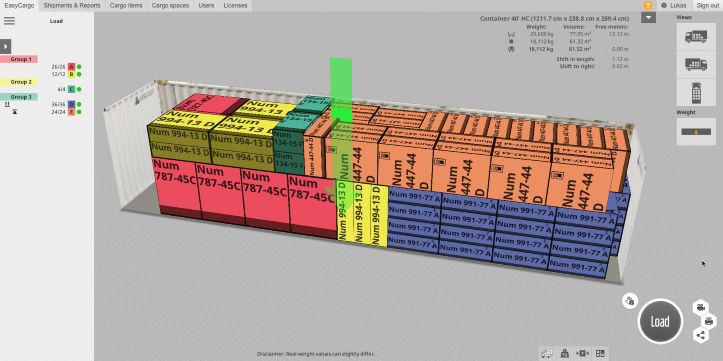
To avoid this, 3D cargo planning is often looked to as an alternative, with the EasyCargo software being an efficient option that speeds up and optimizes cargo and cubing calculations in containers.
How does EasyCargo protect fragile items?
The strength of digital planning lies in the synergy between the operator’s technical knowledge and the tool’s calculation power. By introducing the specific parameters of the merchandise, EasyCargo assumes the complexity of the spatial design, instantly translating those guidelines into an optimal and three-dimensional cargo plan.
To solve the fragile cargo dilemma in critical sectors such as food, liquids, or electronics, the optimization algorithm processes the cargo data and the restrictions introduced by the user, establishing a cargo distribution in the container that respects:
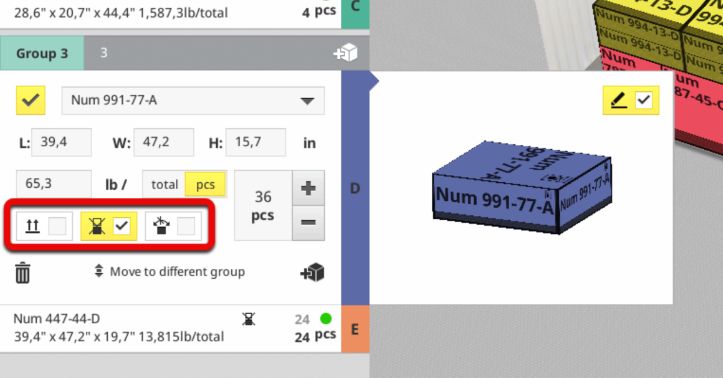
- The configuration of stacking limits: The user simply indicates if an item is “non-stackable.” The software processes this instruction to ensure that weight is never placed on these goods.
- The blocking of rotation and orientation: It is possible to restrict the movement and tilt of items in the EasyCargo interface. This guarantees that critical safety indications, such as “this side up” or verticality in the transport of liquids, are strictly respected in the final design.
- Segmentation by priority groups: This allows classifying up to 10,000 recommended items into 50 different groups. This function facilitates both the physical separation of fragile merchandise and the planning of orderly unloadings on multi-journey delivery routes.
The utilization of three-dimensional space
The advantage of the EasyCargo algorithm is that, upon receiving the instruction that an item is non-stackable, it does not generate a “dead gap.” The system analyzes the available inventory and distributes the merchandise optimally from the base of the container upwards. In this way, the products indicated as non-stackable (fragile) are safely located at the top, and the adjacent spaces are utilized to the maximum with the rest of the compatible cargo.
Therefore, to protect fragile merchandise and prevent other elements from being stacked on them, it is sufficient to indicate to the system the option that is most convenient for you according to the characteristics of the items to be loaded:
- Configure said items explicitly as non-stackable for automatic loading.
- Adjust the cargo plan manually if considered necessary.
- Divide them into priority groups and disable stacking between groups.
Integration and automation in daily planning: Security before the dock
The digitalization of the stowage process brings predictability to operations and reduces the margin of human error before the first pallet reaches the dispatch area. In the case of delicate merchandise, this makes the difference between a safe load and a disaster en route.
Interactive 3D simulation: Preventing operator error
Traditionally, the planner designs the load on paper or in Excel, and the forklift driver interprets it on the dock according to their own criteria. With fragile merchandise, this is a danger: it is enough for the operator to decide to place a heavy pallet on top of a delicate one “because it fit better” to ruin the shipment.
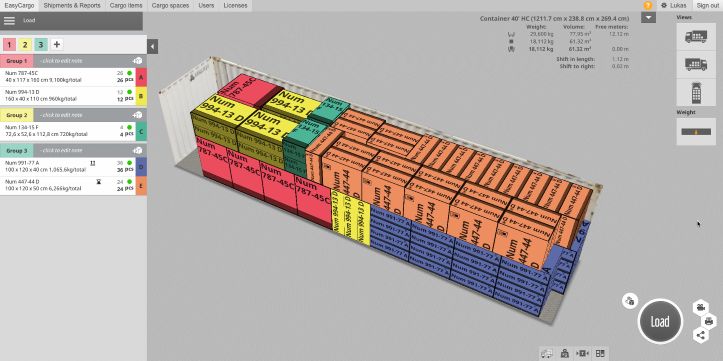
- The real value: EasyCargo presents an interactive 3D interface that allows rotating, zooming, and verifying the exact placement of each element. This works as an undeniable visual guide for the warehouse team. By handing them the exact 3D plan, improvisation on the loading dock is eliminated: the operator sees exactly what goes on the bottom, what goes on top, and which references are prohibited from supporting weight.
Weight control and general balance of the load
When planning fragile merchandise, it is common to place it near the doors to protect it. However, concentrating the weight at one single end unbalances the container’s center of gravity, which generates risks during hoisting at the port or navigation.
- The real value: The platform allows defining the maximum total weight limit and configuring whether to transfer the load to the center of gravity. The platform also provides visual indicators on the distribution of the load in the container, through the weight distribution panel and the informative panel of the load data. This makes it easier for the planner to control and verify if changes are necessary to obtain a safe distribution of the merchandise, helping to prevent container listings or rejections in port terminals due to non-compliance with the verified gross mass (VGM).
Data flow and integrations: Automating restrictions without manual failures
The risk of breakage usually begins at data entry. If an operator forgets to manually mark that an item is “non-stackable,” the load will be treated as general merchandise. To avoid manual oversights, EasyCargo allows automating the transfer of fragility restrictions through:
- Import via MS Excel: A direct template is provided where each SKU preserves its dimensions, weights, and specific rules of stacking and orientation.
- Integration via API, SAP, and Make: The possibility of connecting the cubing software with your pre-existing systems is available so that the transfer of load data is reliable and the workflow remains agile.
Maximize the profitability of your shipments by protecting the most delicate cargo
Guaranteeing that delicate merchandise arrives intact at its destination without wasting useful volume in the container is an operational challenge that is solved today with technology. With EasyCargo, your team can configure stacking restrictions in seconds, calculate the weight balance, and generate precise stowage instructions before moving the first pallet on the dock.
You can optimize the stowage of your fragile merchandise with the EasyCargo 3D simulator for 10 days for free or request a demonstration with the technical team.